PaymentsJournal Podcast: Agentic Commerce and Trust

In Agentic Commerce, Trust Has to Come First
The era when banks and businesses could earn trust gradually, across repeated interactions, has largely closed. Today's digital ecosystem is impersonal, fraud is more sophisticated, and confidence is harder to build and easier to lose. As agentic commerce takes hold, the challenge compounds: it is no longer enough to verify the people in a transaction. The AI agents acting on their behalf, and the intentions behind them, must be verified too.
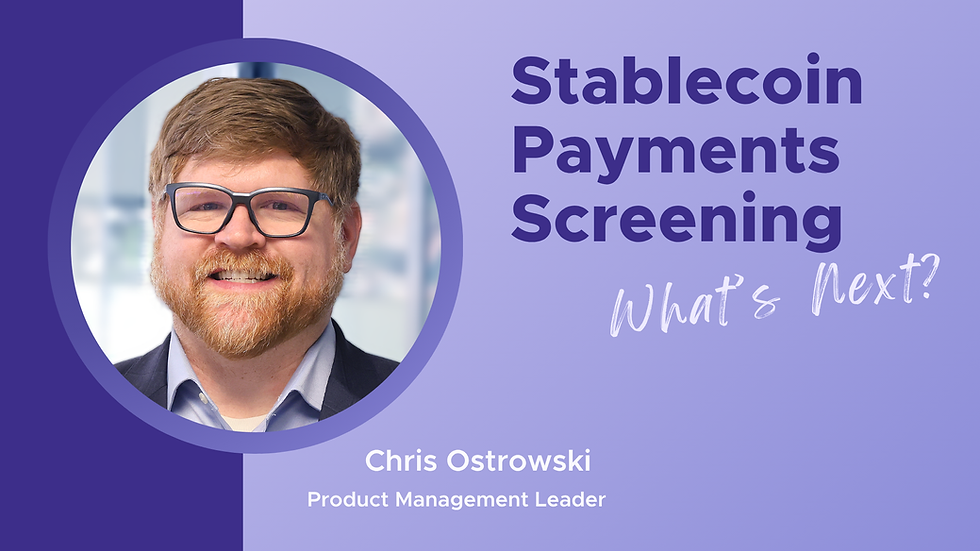
In a recent PaymentsJournal podcast, FinScan's Chris Ostrowski, Head of Product Management, and Kieran Holland, Global Head of Solutions Engineering, joined Christopher Miller, Lead Emerging Payments Analyst at Javelin Strategy & Research, to discuss why trust has become the deciding factor, and why much of the work of establishing it now happens long before a transaction executes.

Confidence in a digital-first world
Many AI improvements have run quietly in the background, from workflow optimization to cybersecurity. Asking consumers to hand shopping and payments to an AI agent asks for something larger. It asks for trust at a moment when fraud has become both relentless and convincing, and when many people have already been caught.
Holland framed it as a question of social change. When an interaction is not face-to-face, people need controls and signals that give them confidence, much as they once relied on reading a person across a counter. Rebuilding that confidence in a digital environment depends on effective risk controls around payments, a task made harder by the spread of payment types now spanning cards, crypto, and real-time rails.
Aligning the industry
Trust does not mean the same thing to every party. As Miller noted, a merchant, an issuer, a processor, and a consumer each need to trust something different before a transaction proceeds, and bringing them into agreement is the real work.
That alignment will likely follow familiar patterns. Ostrowski pointed to the way U.S. banks came together around Zelle, putting shared safeguards in place at a common level, and expects larger institutions to introduce agentic commerce through limited, well-defined use cases that build familiarity over time. He also pointed to the growth of trust registries, where agents earn verified standing that travels with them, including cryptographic methods that assign rights and transactions to specific agents.
Data is the foundation
A consortium approach depends on clear, standardized communication. ISO 20022 was not designed with agentic commerce in mind, but its structured data model fits the need. It identifies the parties to a transaction, from ultimate debtor and creditor to intermediaries, with the clarity that automated compliance decisions require.
That foundation matters because AI within compliance is only as reliable as the data beneath it. Without dependable information about who is involved, automated decisions carry real risk. The same structured data also helps distinguish stablecoin transactions from other crypto transfers and supports requirements such as the travel rule, which is why Ostrowski sees stablecoins and agentic commerce drawing on the same ISO 20022 fields as they scale.
The human stays in the loop
Stronger standards, efficient infrastructure, and better safeguards all support trust. None of them replaces human judgment. Holland described the human as a creativity buffer: a tightly structured system will eventually meet a scenario it cannot handle, and a person can recognize that a purchase fits the rules yet still does not make sense.
Ostrowski connected this to the regulatory environment, where supervisors are not ready to hand risk evaluation or compliance approvals to agents outright. They still want a person reviewing cases and making the final call on whether to onboard or reject. The agent can do the majority of the work. The final decision stays human.