Where AML is Headed: Five Forces Shaping Compliance in 2026


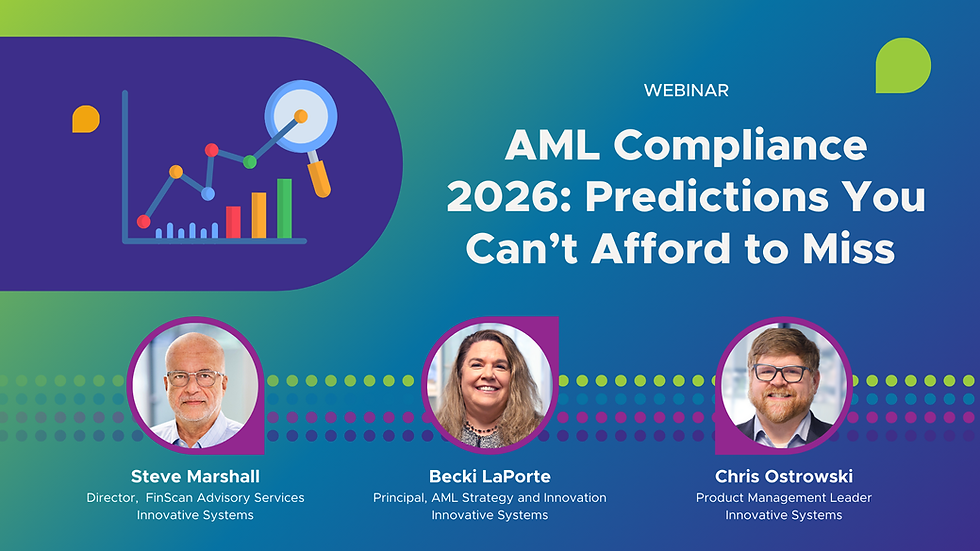
Financial institutions are navigating a landscape where risks move faster, regulatory expectations increase even more, and the stakes for getting compliance wrong have never been greater. That was the central theme of FinScan’s recent webinar, AML Compliance 2026: Predictions You Can’t Afford to Miss, featuring our anti-money laundering (AML), compliance, and technology experts Steve Marshall, Becki LaPorte, and Chris Ostrowski. Below are the five chief insights they believe every compliance leader should carry into the new year.
1. Enforcement is evolving—and financial growth is on the line
While penalties remain significant, regulators are escalating the impact of enforcement through growth restrictions that can last for years. For fast-growing organizations, especially digital payment firms, being told they cannot expand until remediation is complete poses an existential threat. The panel emphasized this shift as a new deterrent: “A fine is annoying, but a growth cap can be a death sentence.”
Regulators are sending a clear message: those with systemic failures and unresolved risks will feel it both financially and strategically.
2. Real-time payments demand real-time compliance
Speed is redefining compliance. Financial crime now moves instantly, and programs built around batch reviews simply can’t keep pace. Faster rails, stablecoins, and blockchain-based transfers require payment screening, fraud prevention, and settlement decisions in seconds.
FinScan product management leader Chris Ostrowski noted that in this new environment, “There’s only so much humans can do… technology must amplify what humans can’t do fast enough.”
Financial institutions that don’t modernize their compliance infrastructure risk being excluded from where commerce is headed.
3. AI is here—but trust, transparency, and governance must lead
AI’s benefits are now well understood: efficiency, pattern recognition, and sharper risk detection. But the risks—bias, hallucination, and over-automation—demand stronger oversight. As FinScan’s regulatory expert and director of advisory services Steve Marshall highlighted, “AI is a tool to supplement, not replace, human assessment.”
Regulators are increasingly focused on explainability and documentation. Many organizations are already creating new governance roles, including chief compliance AI officers, to ensure model behavior aligns with regulatory expectations.
4. The tone from the top will separate the compliant from the vulnerable
Tone isn’t what leadership says about compliance; it’s what they fund. Becki LaPorte, FinScan’s principal of innovation and strategy, made this point unequivocally: seeming to prioritize compliance while running a “skeleton crew with 20-year-old tech” communicates a very different reality.
Organizations that thrive in this new era will be those that reinforce compliance with strategic attention, talent and resource investment, and direct engagement with regulators before problems escalate
In short, a strong compliance culture is no longer a differentiator—it’s a survival requirement.
5. Compliance roles are changing, faster than ever
Entry-level compliance positions are disappearing as automation eliminates routine tasks. Compliance teams now seek hybrid professionals who blend regulatory knowledge with technology fluency, analytics skills, and cross-business insight.
As criminals innovate across channels, compliance skills and careers must evolve the same way. Those who understand the full ecosystem of how money moves will be positioned at the forefront of the profession’s future.
So… is traditional compliance dead?
Not exactly, but the box-checking era certainly is. The road to 2026 demands five key success factors:
Better technology with stronger governance
Faster, proactive detection capabilities
Elevated workforce skills
Authentic leadership commitment
Continuous regulator engagement
As the panel discussion concluded, the mission remains constant. But the methods must advance as quickly as the criminals and commerce they aim to protect.
Missed the live webinar?

Watch the replay for a deeper dive into the key trends we can expect to see in 2026.